
Systems Change
We need to fix the system, not the women.

Elect Her are leading on innovative solutions-focused and collaborative work with stakeholders supporting women in democracy to dismantle the barriers that women face.
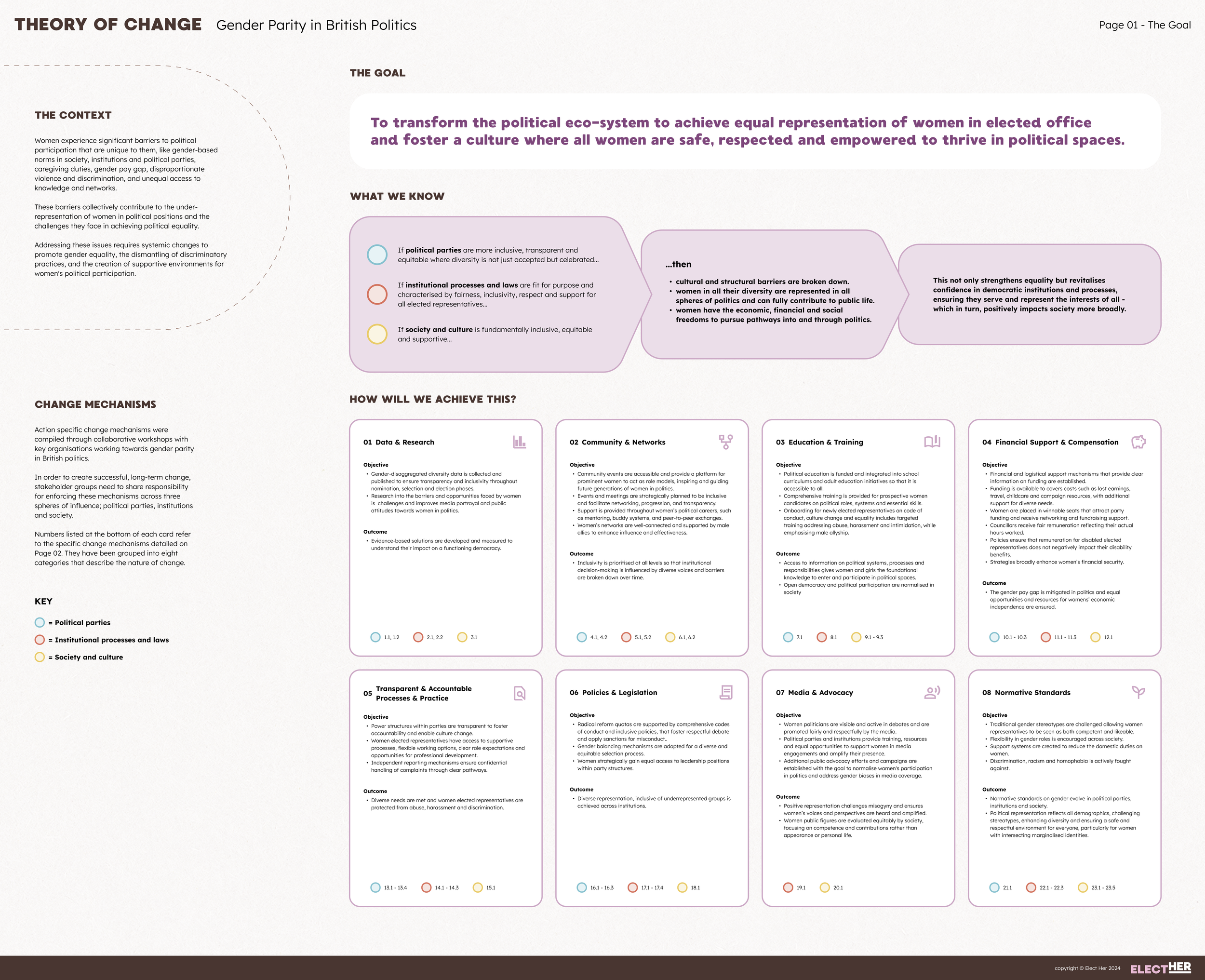
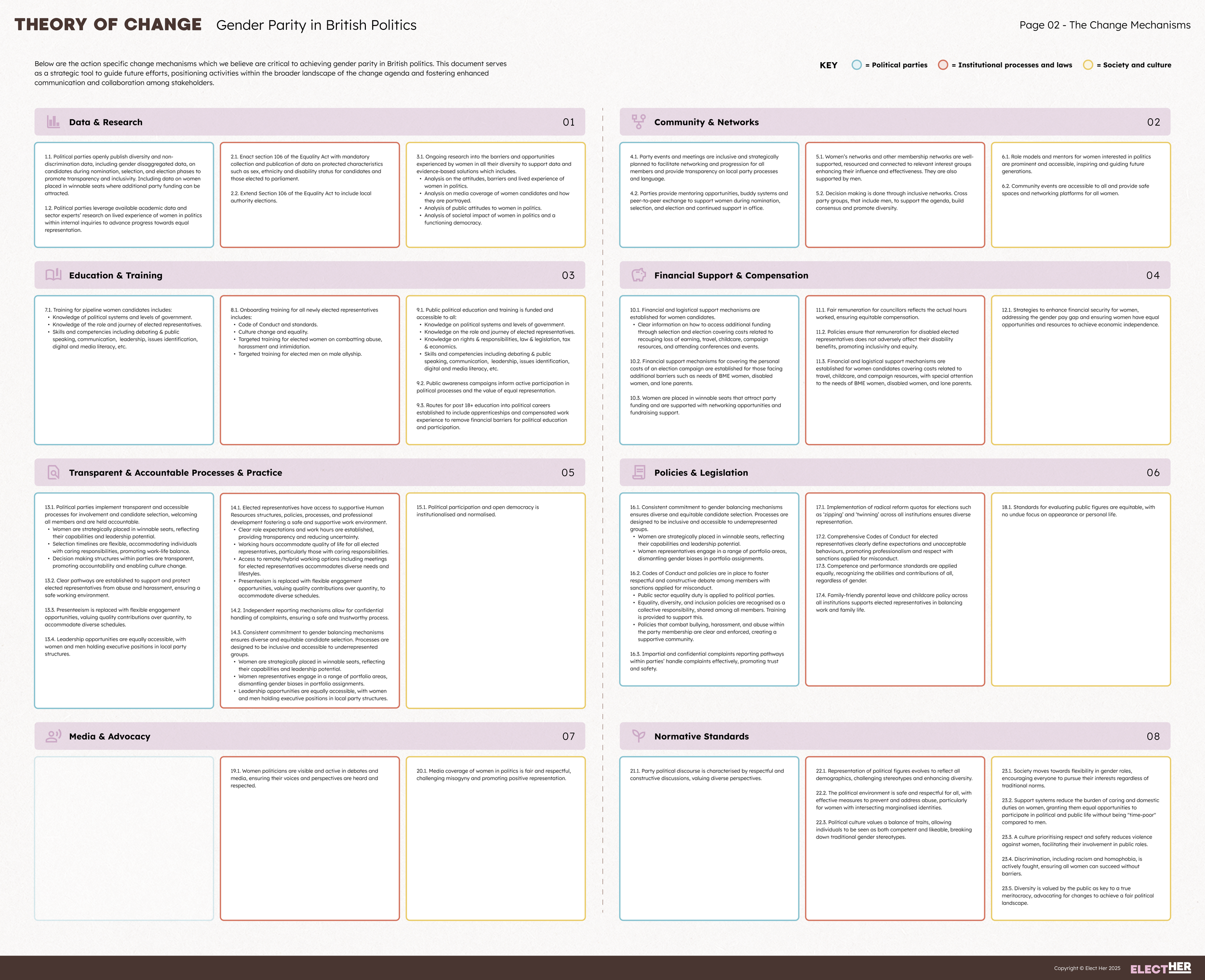
Working with key civil society organisations, political institutions and political parties, we’ve worked to outline the main barriers women face entering politics, and the subsequent change mechanisms that need to be enacted in order for us to achieve equal gender representation in politics. Read our theory of change to understand the evolution of this work, and what we’re aiming towards.
Barriers for Women’s Political Participation
-
Wider culture and society
Patriarchal gendered role expectations continue to underpin the roles that women and men are socialised towards, public sphere = for men, private sphere = for women.
“Default” politician in public subconscious is a white, older, wealthier man - women competing against stereotypes.
Women continue to carry out disproportionate childcare and other caring responsibilities - less free time to spend on political activism.
Widespread violence against women and girls (VAWG) in culture generally, increased risk for women in public eye. Women avoid politics as act of self-preservation.
Racism, and all of the ways that it shapes society and impacts women of colour within/in addition to gendered barriers
Ableism and all of the ways that it shapes society and impacts disabled women within/in addition to gendered barriers.
Homophobia, biphobia, transphobia and all of the ways that these factors shape society and impact women lesbian, bisexual and trans women within / in addition to gendered barriers.
Lack of access to political knowledge/education/information across much of society
Backlash towards interventions/redress of any kind (“wokeness” gone too far)
Public belief that we live in a meritocracy and current status quo reflects “natural” order in politics
Crisis of confidence in democracy. Lack of diversity in decision making means institutions often fail communities; which favours perpetuation of status quo.
2. Economic & Financial Realities
Women are more likely to experience financial insecurity than men, and are likely to have lower disposable income than their male counterparts, with the cost of living crisis compounding this situation.
Women have less financial freedom to devote to campaigning which often involve significant unavoidable costs for candidates and activists relating to travel, childcare, time off work, and provision of campaign resources and materials. This likely has greatest impact on certain groups of women who already experience higher rates of exclusion including BME women, disabled women and lone parents.
Women are “time-poor” in comparison to men due to volume of competing responsibilities including caring and domestic duties.
-
Terms and Conditions and Working Practice
Councillors remuneration is not fair based on hours worked.
Inconsistent parental leave / childcare policy for elected representative across all institutions - not family-friendly working environments
Hours of business are not compatible with quality of life for elected representatives - in particular those with caring responsibilities who continue to disproportionately be women.
Inadequate codes of conduct for elected representatives with examples of unacceptable behaviour
There is a lack of independent reporting mechanisms within institutions to handle complaints confidentially.
Elected representatives don’t have access to the same level of workplace protections and support as other employees:
Human Resources structures, policies & processes in place to support elected representatives as employees, to feel supported in their work and to work within a safe environment.
There is a lack of clarity for role expectations and expected hours
Lack of consistent access to remote/hybrid working for elected representatives.
For disabled elected representatives there is a lack of clarity around impacts of remuneration on disability benefits
Lack of quotas in place for elections to all institutions
Lack of robust data available from institutions on diversity of elected representatives
Lack of gender balance within leadership roles
2. Political Culture (democratic institutions but also applicable in parties/elsewhere)
Different standards – more scrutiny over women’s appearance and personal life by public/party/colleagues
Different standards – higher competence bar in terms of work performance than for men to be taken seriously
Double-bind for women politicians based on cultural expectations – can be seen as either competent (leaning into masculine traits ie strength, assertiveness) or likeable (leaning into feminised traits ie nurturing, emotional) – rarely both.
Women more likely to be funnelled into softer/”feminised” portfolio areas i.e health, social care, education which may not be taken as seriously; harder/”masculinised” areas i.e finance, economy, defence which are often prioritised.
Political debate in and out of institutions is highly masculinised, esteems & rewards aggressive, confrontational interactions
Women politicians less visible – less likely to speak in debates, be quoted in media
Low multi term retention of women – lack of women’s informal institutional knowledge, networks etc being built up and retained.
Lack of role models for women
Abuse of women in politics- online and offline - (women with intersecting marginalised identities at greatest risk)
“Old Boys Club” Networks shaping decisions – excluding women
Media coverage of women in politics often rooted in misogyny and perpetuates it
-
Processes & policies & structures
Lack of transparent processes for getting involved in political parties
Lack of transparent, easily-accessible processes for candidate selection
Lack of consistent commitment to gender balancing mechanisms for candidate selection
Candidate selection processes which do not work for /are not accessible to already underrepresented groups
Women are more likely to be selected for marginal seats when running for office
Selection processes typically do not operate on timeframes which work for people with caring responsibilities
Political parties do not publish diversity data on successful/unsuccessful candidates during nomination, selection and election.
Parties and institutions do not often have clear pathways to support and protect elected representatives who receive abuse and harassment
Lack of clear codes of conduct/policies to lessen hostility in debate among members
Lack of clear, impartial reporting pathways within parties to handle complaints confidentially.
Lack of clear policies to tackle bullying, harassment and abuse among wider membership
2. Party culture
Aggressive, overly confrontational style of discussion and debate
Equality, diversity and inclusion work usually falls on women (and other groups experiencing exclusion) as additional workload.
Women more likely to be in junior/supportive roles in local party structures with men in executive positions.
Presenteeism - Rewarding hours spent canvassing with opportunities for progression (including candidate selection) – disadvantages those with less free time. Women are typically time-poor compared with men.
Social events are often not inclusive (time, location etc) but can be essential for progression.
Women’s networks/other membership networks not well resourced.
Power structures in parties can be opaque which is a barrier to accountability
Importance of hierarchy in political parties – a barrier to culture change

Changing the future of democracy.
Together with Engender Scotland, we hosted a workshop to map the equal representation landscape and to develop a collective theory of change to support individual and combined efforts.
We brought together 29 participants from 17 organisations spanning political parties, the equalities sector, government bodies, and academic institutions.
What we found is summarised here, alongside the next steps to creating our framework for achieving women’s equal representation in Scotland.