
Where Are Labour’s Women in the Leadership Conversation?
By Dr Annabel Mullin
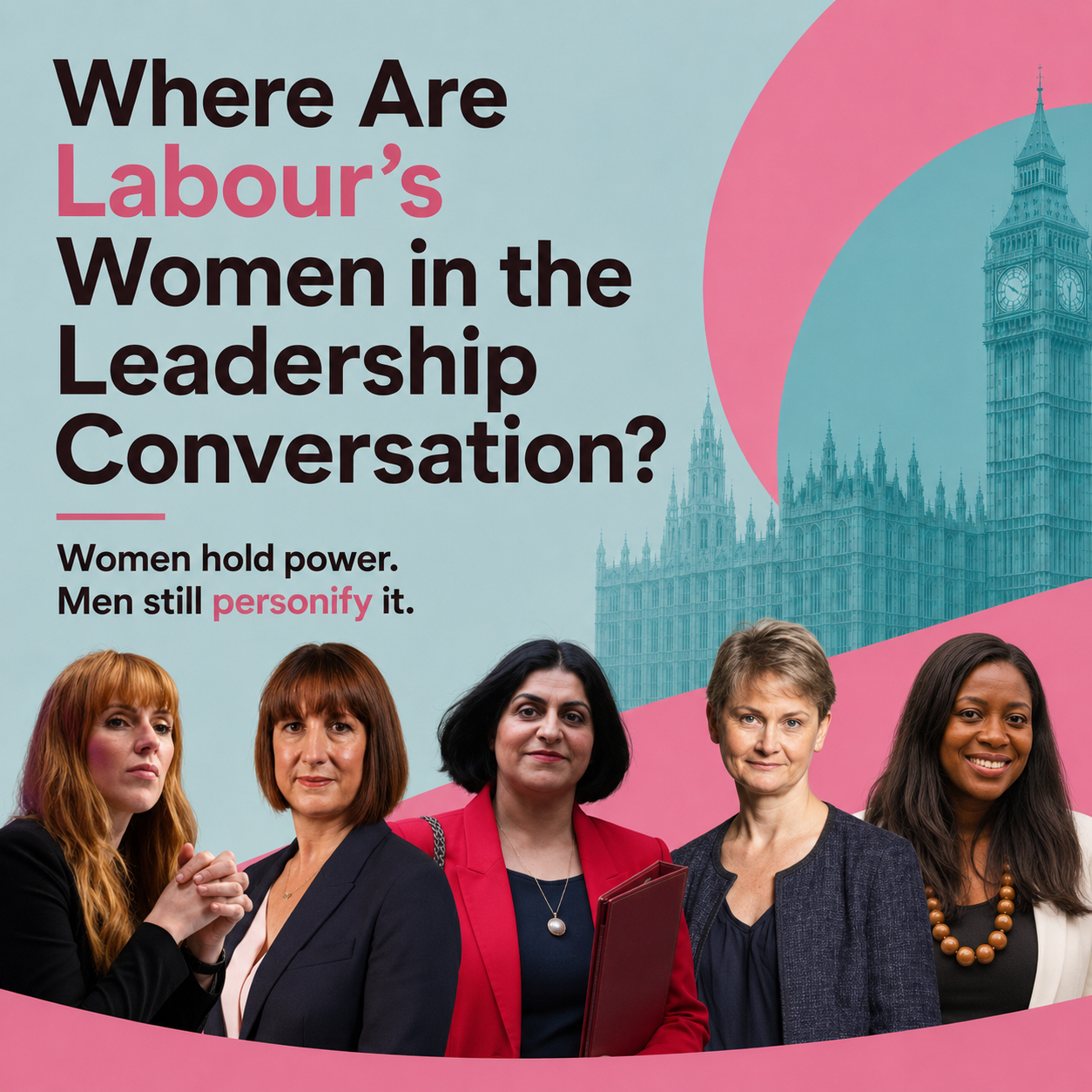
Women hold power.
Men still personify it.
Rachel, Yvette, Angela, Shabana, Miatta - why do these names so rarely appear when Britain talks about political leadership?
Listen to the conversations about Labour’s future - on panels, in columns, across Westminster gossip - and the same names surface again and again. Keir. Wes. Andy. The men around the machine, the operators, the future?
And yet this government contains some of the most powerful women in modern British politics.
Rachel Reeves runs the economy at a moment of profound national anxiety. Yvette Cooper oversees immigration, policing and national security - one of the great offices of state. Angela Rayner remains central to Labour’s emotional and political identity, bridging the parliamentary party and labour movement roots that still shape its legitimacy. Shabana Mahmood occupies one of the most constitutionally serious briefs in government. And Miatta Fahnbulleh represents a newer generation of Labour talent: intellectual, policy-driven and increasingly influential in shaping the party’s future direction.
These are not peripheral figures. They are exercising real state power over the economy, justice, migration.... Yet when Britain talks about “the leadership”, the conversation still instinctively tilts toward men.
Of course, the immediate response is that these women are politically different from one another. Angela Rayner is not Rachel Reeves. Yvette Cooper is not Shabana Mahmood. Miatta Fahnbulleh does not belong to the same ideological tradition as any of them. Labour itself is a broad and often uneasy coalition: soft left, technocratic, trade unionist, managerial, socially conservative, socially liberal.
But so what?
Male politicians are never denied collective political visibility because they disagree with one another. No one insists that we cannot talk about male leadership because Wes Streeting is not Andy Burnham. Men are allowed ideological range while still being understood collectively as political protagonists. Women, by contrast, are treated as isolated exceptions.
And so Labour’s women are fragmented into categories. The competent one. The difficult one. The loyal one. The ambitious one. The technocrat. The working-class one. Rarely simply leaders.
That distinction matters because politics is not only about who holds office. It is also about who gets mythologised. Who is imagined as shaping history rather than merely administering it. The men of Westminster are routinely discussed as if they are architects of the future.
Even the language reveals the imbalance. Men are “serious”, “visionary”, “strategic”, “ruthless”, “future leaders”. Women are “steady”, “competent”, “safe”, “divisive”, “shrill”, “difficult”, “ambitious”. A male politician’s ambition is read as evidence of drive. A female politician’s ambition is still often treated as evidence of personal appetite.
The irony is that many of these women hold exactly the kind of portfolios that historically created male prime ministers. The Treasury, the Home Office and Justice have long been seen as proving grounds for national leadership. Yet the women occupying those offices rarely receive the same narrative treatment as the men who held them before.
That gap between formal power and symbolic power is where the real issue lies.
Britain has undeniably changed. The country has produced a female prime minister who reshaped the modern state, female home secretaries, party leaders and first ministers. The argument is no longer about whether women can reach power. They can and do. The more interesting question is why political leadership itself still feels culturally coded as male - and why the traits most associated with authority in Westminster remain confrontation, dominance and theatrical certainty rather than collaboration, resilience or institutional competence.
Because perhaps the deeper issue is not simply who gets into politics, but what politics still chooses to reward.
This becomes especially obvious in the way Westminster narrates Labour’s internal dynamics. Conversations about direction, vision and authority still circle overwhelmingly around men even when women are carrying some of the government’s heaviest burdens. Male politicians are framed as generating political meaning; women as implementing it.
And that matters beyond Westminster itself.
Politics is partly theatre, partly storytelling. The public absorbs subtle signals about who counts as authoritative, who appears “prime ministerial”, whose voice sounds naturally national. Young women watching politics are still being taught, quietly but persistently, that authority sounds male.
None of this requires pretending these women are flawless, universally popular or politically aligned. Nor is it an argument for symbolic sisterhood. It is simply an observation about visibility and imagination. Men are permitted complexity without losing their status as leaders. Women are still forced to justify their presence individually, repeatedly and defensively.
Perhaps that is the final barrier in British politics. Women can now hold power at the highest levels of government. But politics has absorbed women far more quickly than it has changed what leadership itself looks like.
And perhaps that is the real question underneath all of this: why has politics become more comfortable with women in power than with the virtues traditionally associated with women shaping power itself?

Donate today to build women up and improve our politics!
Blog idea or comment piece?
Would you like to contribute to this blog series? We’d love to hear from you. Send us your ideas and let’s chat: community@elect-her.org.uk.