
Who represents Scotland? Class and gender of Holyrood in 2026
By Shevaun Smith
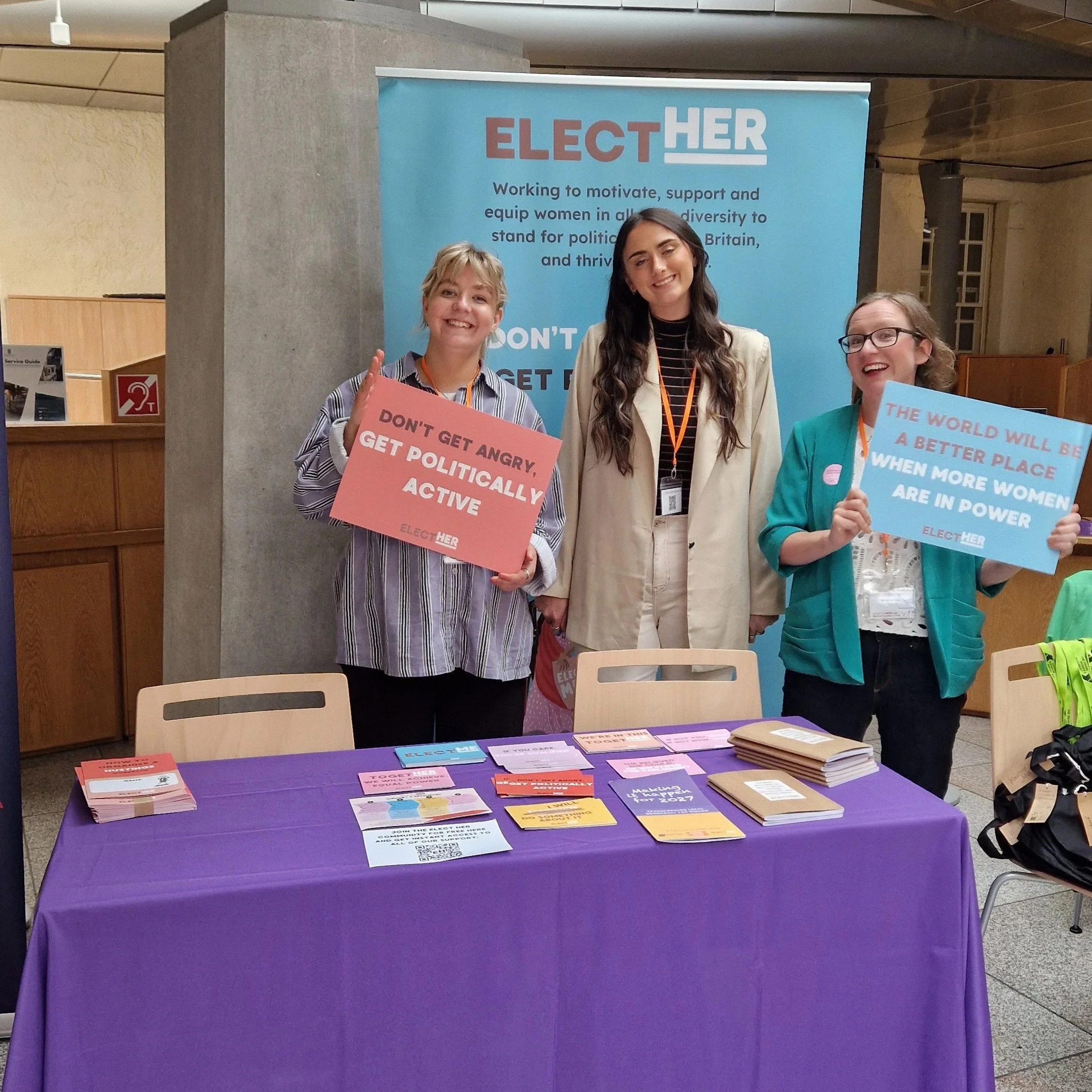
Shevaun (in the middle in this picture) is a PhD researcher at the University of Strathclyde, working in collaboration with Elect Her. Her research examines how class and gender shape political representation in Scotland and the UK.
The underrepresentation of women in elected office is widely debated. But social class rarely gets the same attention. Fewer politicians now come from working-class jobs in trades, retail, care work, and more come from professional and political careers. Who gets into parliament shapes what parliament does, and whose interests it serves.
Holyrood was designed to be different from Westminster.
Its proportional electoral system and founding principle of equal opportunities were meant to produce a legislature that looked more like Scotland. On gender, Holyrood remains more gender-balanced than Westminster, but 2026 represents a step back from 2021’s record high of 45% women. The 2026 cohort stands at 43% women, but remains short of parity.
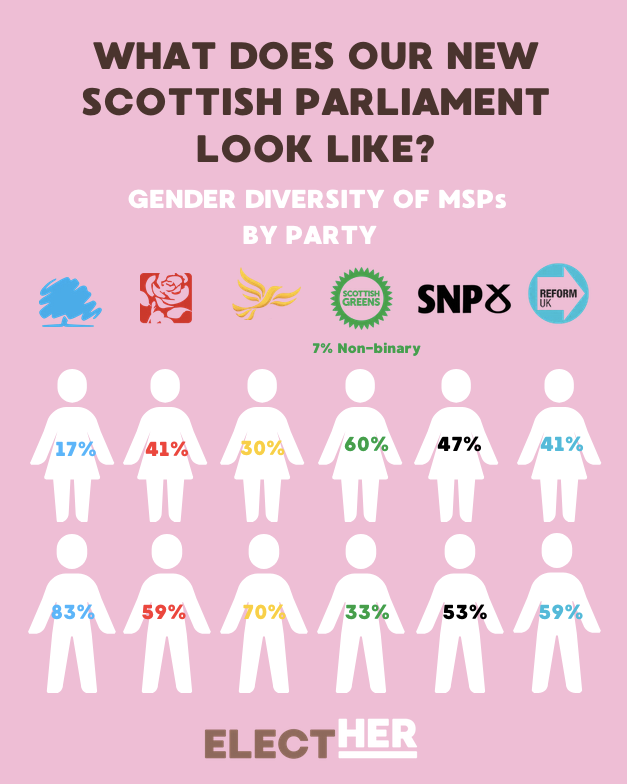
On gender, Holyrood remains more gender-balanced than Westminster, but 2026 represents a step back from 2021’s record high of 45% women.
On class, the picture is starker. Just one of 129 elected MSPs comes from a working-class occupational background. Alongside this working-class MSP sits a parliament in which three in ten built careers behind the scenes in politics, as parliamentary staff and party employees. The rest come almost entirely from professional and managerial backgrounds.
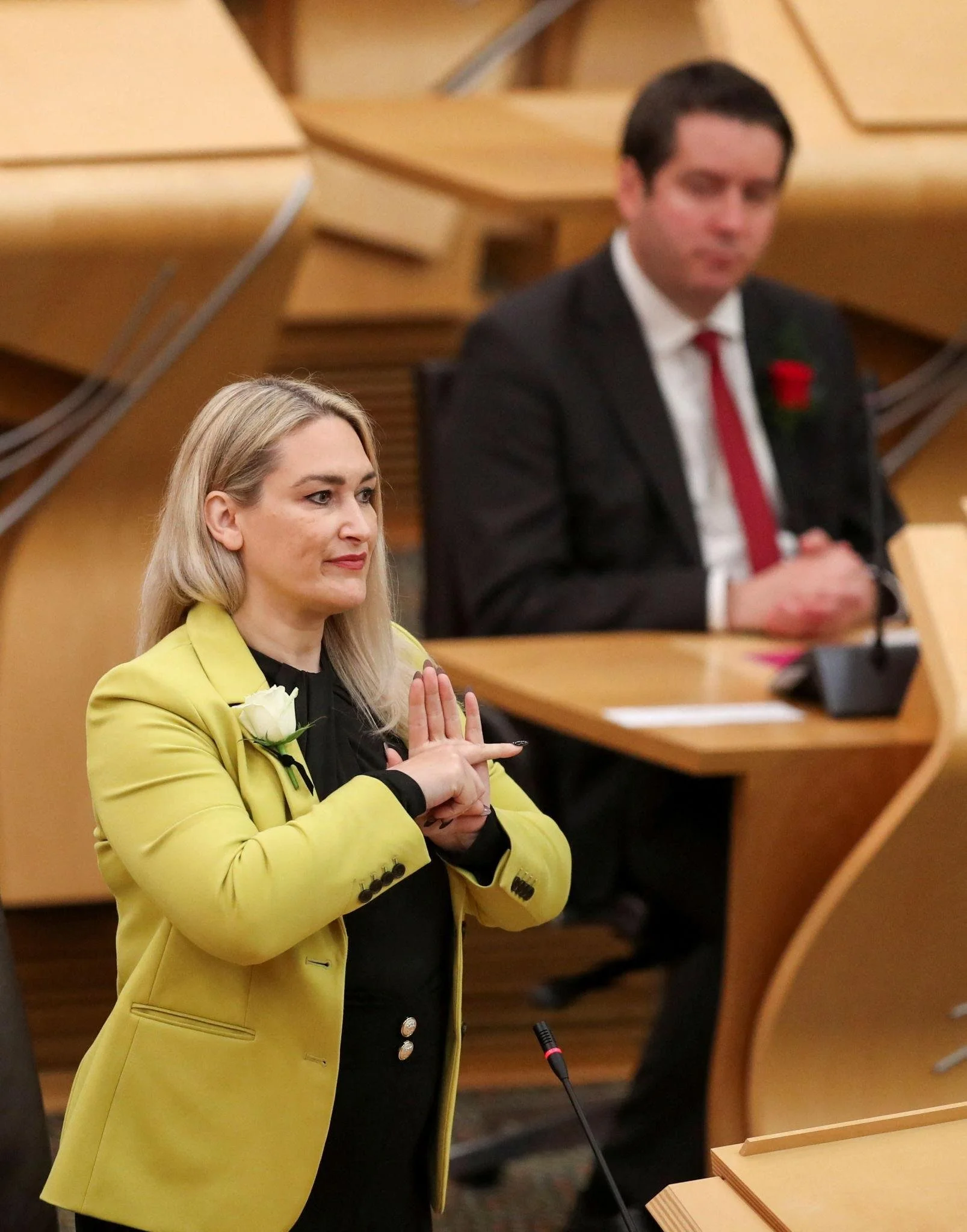
The only working-class MSP is Karen Adam of the SNP, re-elected in Banffshire and Buchan Coast.
The only working-class MSP is Karen Adam of the SNP, re-elected in Banffshire and Buchan Coast. Before becoming a councillor, Adam had jobs in hairdressing and retail while raising six children. Her path to Holyrood ran through local volunteering, party activism and service as an SNP branch convenor. Her biography matters not because it is exceptional in Scottish society, but because it is exceptional in the Scottish Parliament. Adam’s case also shows why class and gender cannot be separated. Working-class women are less likely to have access to political networks, and more likely to have caring responsibilities, interrupted employment histories and jobs that offer little flexibility for unpaid political work. Her presence in the 2026 cohort is important; the problem is that she stands alone.
Social class can be measured in different ways: background, income, education, and occupation each tell different stories. My analysis uses prior occupation, the main job a candidate held before entering politics, capturing income, skills, networks and life chances. Working-class occupations are defined here as manual, routine, service, care and retail roles, as opposed to professional or political careers. Where candidates served as councillors before standing for Holyrood, the occupation recorded is the one held before entering elected office. Note that those who moved directly from education into elected office are omitted, as are those for whom no occupational information was available (seven MSPs).
My analysis focuses on an occupational-background measure, not a complete measure of class identity. Some MSPs coded as middle class may have grown up in working-class households, and that experience matters. But entering politics while holding a working-class job is different from doing so after moving into a more secure, flexible and better-networked occupation.
Without deliberate action, comparable to the mechanisms that have partially improved gender representation, there is little reason to expect the class composition of the 2031 cohort to look any different.
Further, not all parties recruit from the same kind of middle-class experience. Two broad routes into Holyrood stand out: the political-professional route, covering parliamentary staff and party employees, and the professional-managerial route, covering law, policy, business, management, health, education, technology and journalism. Both offer distinct advantages: political networks and insider knowledge on one side; resources, flexibility and professional credibility on the other. Political staff roles can provide routes into politics for people with less advantaged backgrounds, but none of the MSPs who took this route came primarily from working-class employment.
The party patterns reflect this. The Liberal Democrats and Greens have the highest proportions of MSPs whose main route into Holyrood was through paid political roles, at 44% and 43% respectively. The Conservatives and SNP sit in the middle, at 33% and 31%. Labour stands at 24%, despite its trade union roots. Reform is the least politically professionalised, at 13%. Five of its fifteen MSPs are self-employed or run small businesses, the highest proportion of any party. Reform’s route is less political-professional than entrepreneurial, but it remains firmly middle-class.
Gender tells a different story. The picture varies by party, but women’s representation is much closer to parity than working-class representation. The Greens returned two transgender MSPs and, at 60% women, are the only party with a female majority. The SNP returned 47% women, while Labour and Reform each returned 41%. Women make up three out of ten Liberal Democrat MSPs, and the Conservatives have the most male-dominated cohort — ten of their twelve MSPs are men. Gender equality mechanisms have had some traction in Scottish politics, but class diversity has no comparable institutional mechanism.
Holyrood in 2026 is marginally more gender-balanced than Westminster. But on class, the gap between the parliament and the population it represents is stark. Parties are beginning to think about how to improve women’s representation. They rarely ask the same of working-class candidates: who is recruited, who is selected, and crucially, who is placed in a seat they can win.
Without deliberate action, comparable to the mechanisms that have partially improved gender representation, there is little reason to expect the class composition of the 2031 cohort to look any different.

Donate today to build women up and improve our politics!
Blog idea or comment piece?
Would you like to contribute to this blog series? We’d love to hear from you. Send us your ideas and let’s chat: community@elect-her.org.uk.