
Progress Is Possible. Progress May Reverse. The pipeline remains broken.
By Elect Her
What the 2026 Elections Tell Us About Women's Representation
The 2026 elections delivered three very different stories about women's representation. In Wales, women came within touching distance of parity in the Senedd. In Scotland, women remain strongly represented in Holyrood, but there are fewer women MSPs than there were after the 2021 election. In England's local elections, women made up just 33% of those elected despite accounting for 51% of the population.
Taken together, the results tell a powerful story about the state of representation in Britain.
Wales demonstrates that progress is possible when representation is taken seriously,
Scotland reminds us that progress can stall or reverse,
and England highlights a political pipeline that remains stubbornly unequal.
Most importantly, the results challenge a common assumption: that women's representation will naturally improve over time.
Recent electoral history suggests otherwise.
The record number of women elected to Westminster in 2024 was a significant milestone. But it was also shaped by the political context of that election and the relative success of parties with stronger records on women's representation. Changes in party fortunes, candidate selection practices and electoral dynamics can all have a significant impact on who gets elected.
The 2026 elections reinforce the same lesson -
Representation is contingent, not guaranteed.
Wales: Progress Is Possible
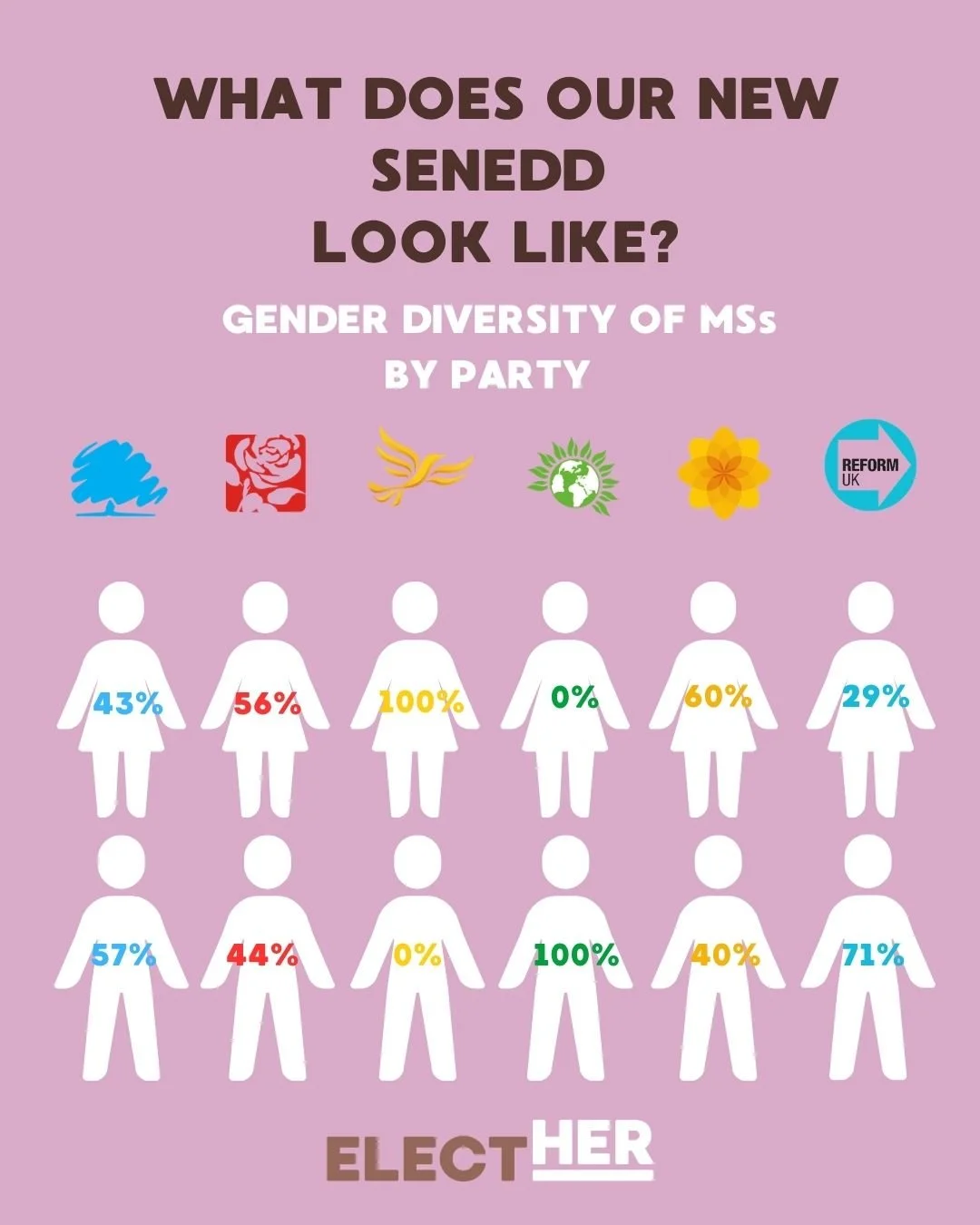
Wales made history as the first legislature in the world to achieve gender equality in 2003. The 2026 Senedd election shows that strong representation remains achievable, with women making up 46.9% of Members of the Senedd.
There are particularly encouraging signs across several parties. Plaid Cymru elected a group that was 60% women, while Labour elected 56% women.
These results did not happen by accident.
For many years, Wales has been taking representation seriously. Positive action measures, including quotas (Plaid Cymru) and gender-balanced selection approaches, have helped create pathways for women into elected office. The results reinforce a growing body of evidence that under-representation is more likely to be explained by barriers at the recruitment and selection stage than by voter bias.
Once women are selected, they are generally just as likely as men to win elections. The challenge lies earlier in the process: who is encouraged, recruited and supported to stand.
The lesson from Wales is clear: progress is possible when it is prioritised.
But representation is not finished once a target is reached. Too many women still face barriers as they step into political life, and for many the experience of politics remains unequal.
The challenge now is to build a culture where more people from all backgrounds can step into politics – and stay!
Scotland: Progress Cannot Be Taken for Granted
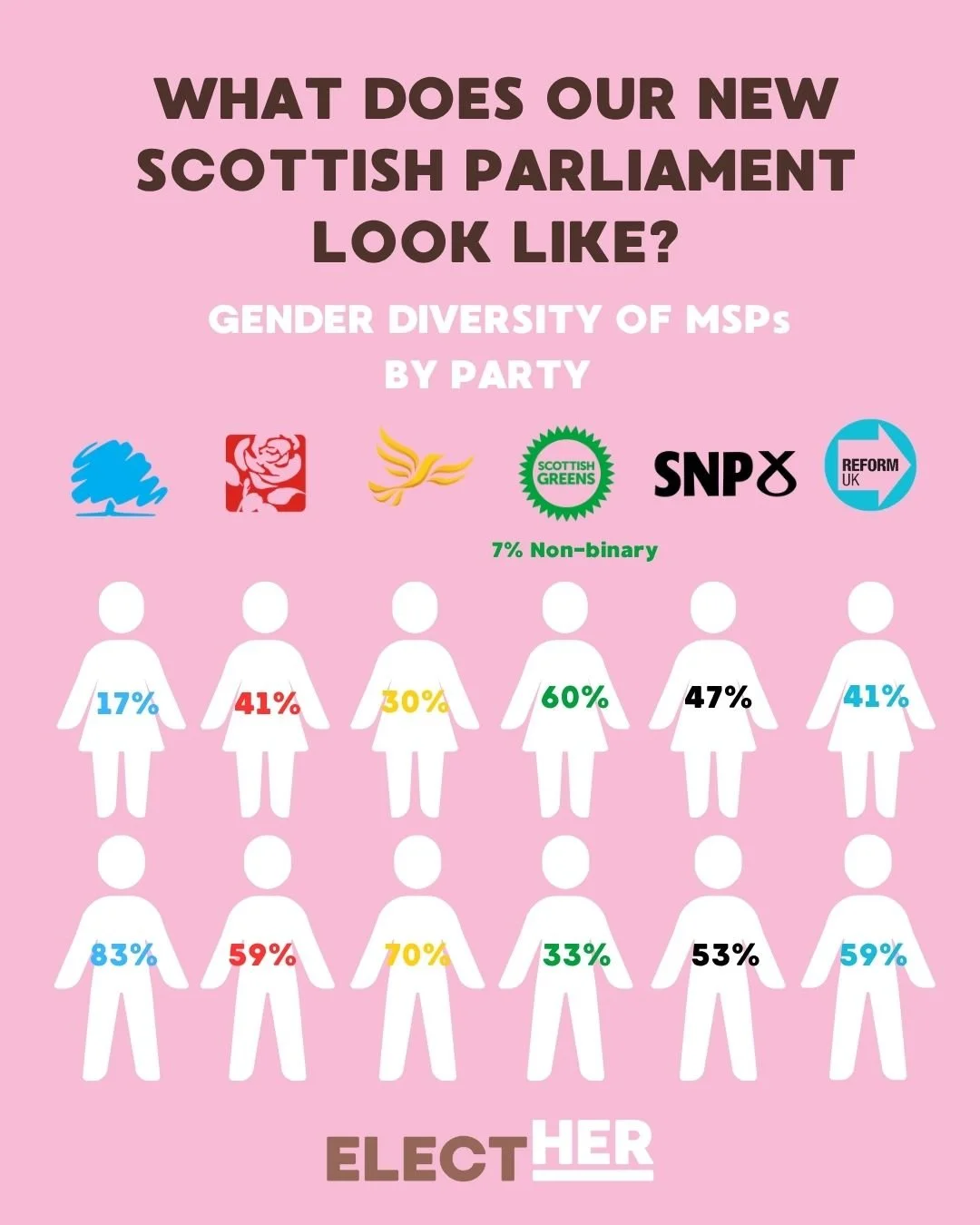
Scotland made history in 2021 by electing the highest number of women MSPs ever returned to Holyrood. The 2026 election tells a more complicated story. Women continue to be well represented in the Scottish Parliament, making up 43.4% of MSPs.
However, there are fewer women MSPs than there were after the 2021 election. That matters.
For many years, discussions about representation have often assumed that progress will continue naturally over time. Scotland reminds us that this is not always the case.
The lesson is not that progress has failed. It is that progress cannot be assumed. Scotland demonstrates that gains which take decades to achieve can be vulnerable to changing political circumstances.
There are positive signs. Representation is becoming broader in a number of ways and several parties continue to elect substantial numbers of women. However, the overall picture demonstrates that progress can stall and gains can be lost.
If representation is to improve further, attention must remain focused on the barriers that continue to prevent women from entering and remaining in political life.
The challenge is not simply getting more women into politics. It is creating a political culture where women feel able to step forward, thrive and stay.
England: The Pipeline Remains Broken
If Wales demonstrates what is possible, England highlights the scale of the challenge that remains.
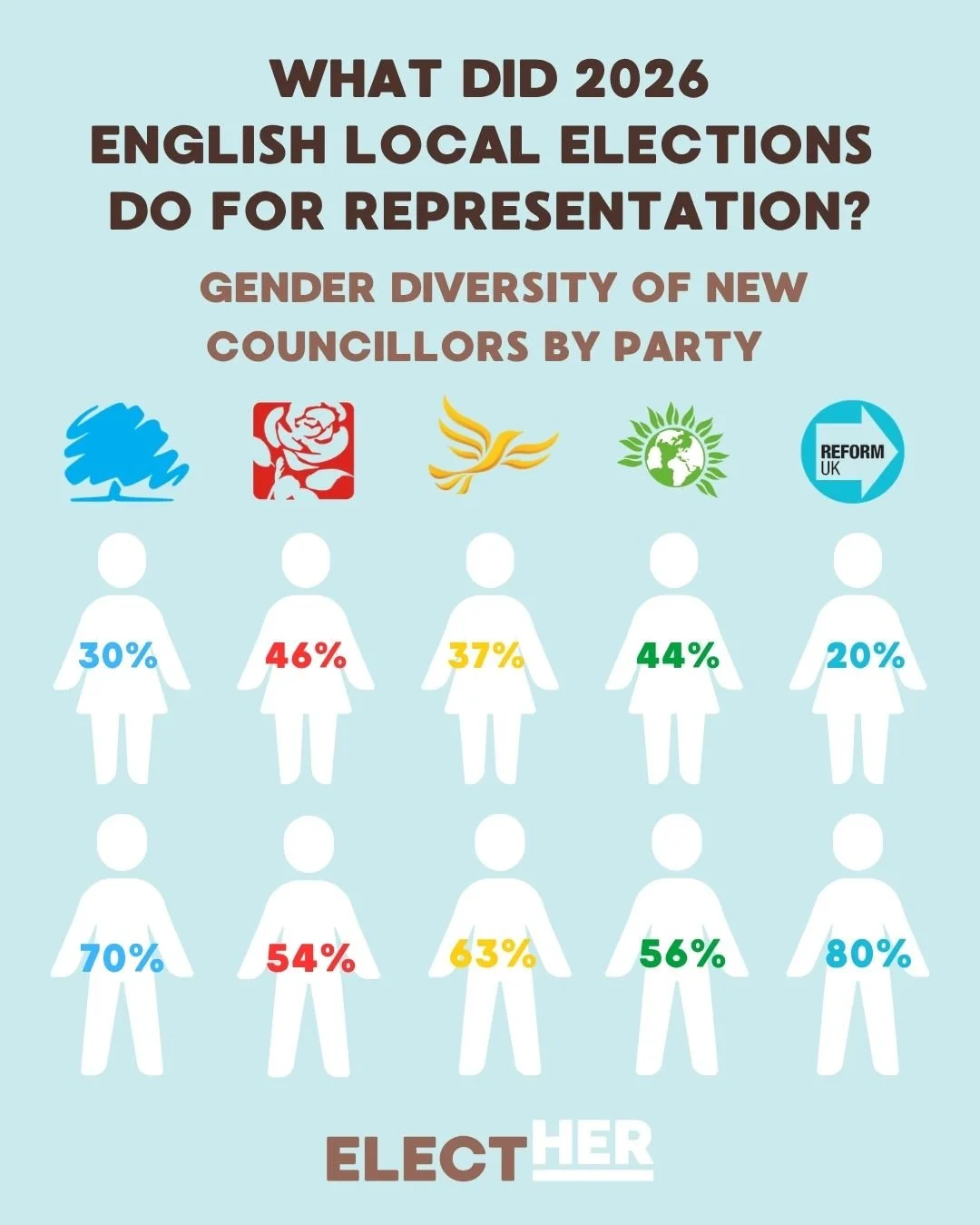
Women make up 51% of the population.
Yet just 31% of candidates in the English local elections were women and only 33% of those elected are women.
The gap is stark.
Local government remains one of the most important routes into political leadership. Councillors become council leaders, mayors, MPs and ministers. When women are underrepresented at the point of entry, inequality is reproduced throughout the political system.
This is why research consistently finds that women's underrepresentation is more likely to be explained by barriers in the political pipeline than by voter bias.
The challenge is often not whether voters will elect women, but whether women are encouraged, recruited and selected to stand in the first place.
The English results suggest that progress has not simply stalled – it is flatlining.
And when women are not equally represented, politics becomes less reflective of the communities it serves and less trusted by the people it represents.
The question is not simply who gets elected.
The question is who gets the opportunity to stand.
What the Results Tell Us
Taken together, the 2026 elections reveal both the possibilities and the fragility of progress. Wales shows what can happen when representation is prioritised and supported through deliberate action. Scotland reminds us that gains can plateau or reverse, even after historic breakthroughs. England demonstrates that the political pipeline remains far from equal, limiting who enters public life in the first place.
Across all three nations, the evidence points in the same direction. Women's underrepresentation is shaped less by voter behaviour than by the systems, structures and cultures that determine who becomes a candidate.
Representation is not self-sustaining. It is shaped by political choices.
Why Support Matters
The issue is not a lack of talented women. Nor is it a lack of women who care about their communities, public services or the future of politics. The challenge is that too many women still encounter barriers before they ever reach the ballot paper.
By encouraging women to consider public office, building confidence, developing practical skills and creating supportive networks, we - and our partners - aim to help address the point at which many women are lost from the political pipeline.
The results from Wales, Scotland and England demonstrate that representation is shaped by political choices. It reflects the systems parties build, the candidates they select and the political environments they create.
Progress is possible, but it is never inevitable.
The challenge now is to ensure that future gains are not dependent on favourable political circumstances alone, but are built into the structures of our democracy.
Representation is contingent, not guaranteed.
Donate today to build women up and improve our politics!
Blog idea or comment piece?
Would you like to contribute to this blog series? We’d love to hear from you. Send us your ideas and let’s chat: community@elect-her.org.uk.