
Why We Signed the Letter to the Prime Minister - and Why It Matters
By Elect Her
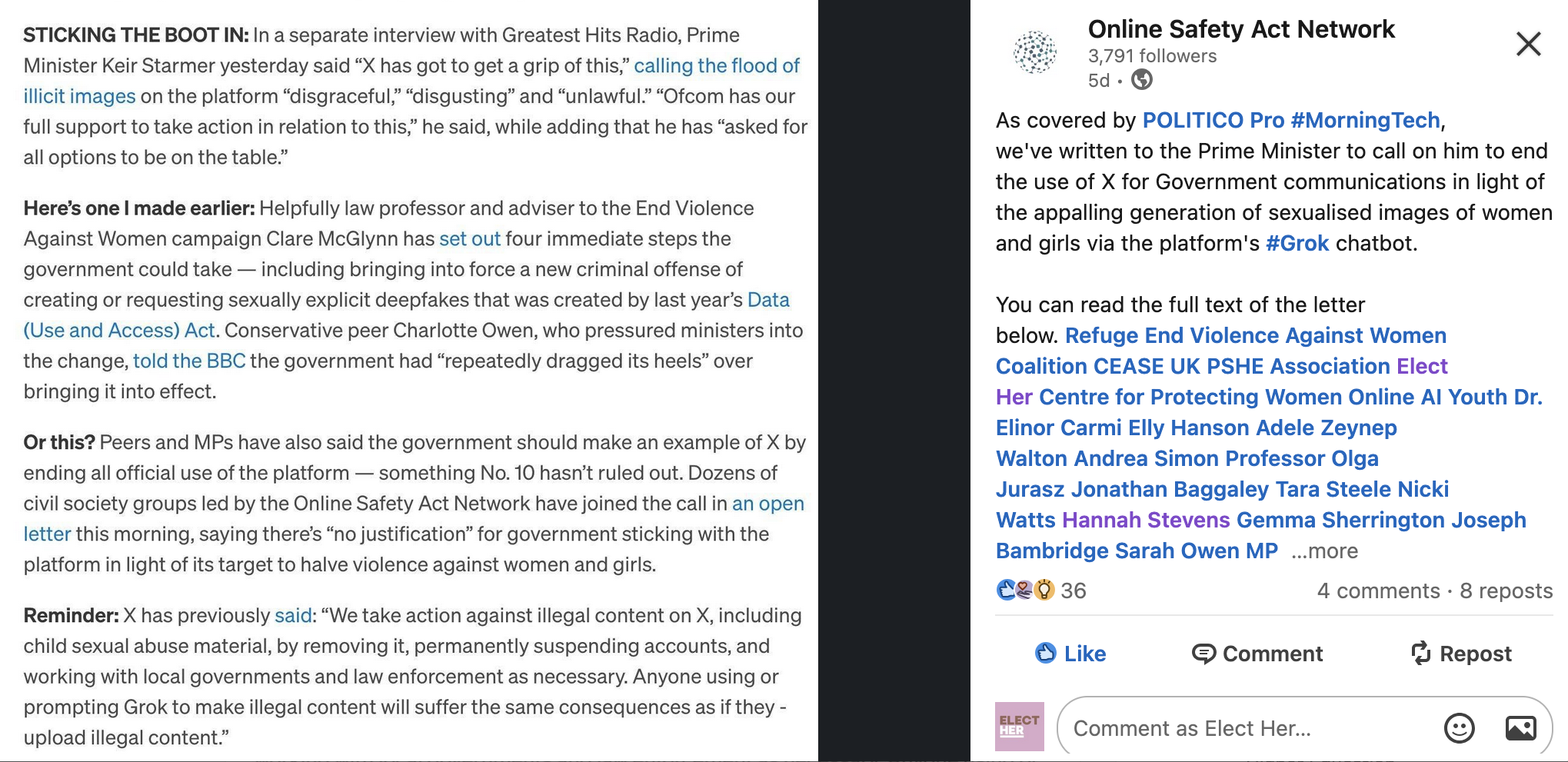
In early January 2026, the Online Safety Act Network - a coalition of civil society organisations, academics and campaigners - came together to send a public letter to the Prime Minister calling on the UK Government to end its use of X (formerly Twitter) for official communications.
We were proud to add our name, in fact Hannah’s our CEO, to that letter —because this moment represents a critical intersection of online safety, gender justice, and democratic responsibility.
What the Letter Says
The letter, coordinated by the Online Safety Act Network, highlights a deeply troubling development on X: the Grok AI chatbot was being used to generate sexualised and dehumanising images of women and girls, including what appear to be undressed images of minors.
The Independent Watch Foundation (IWF) identified instances of category C child sexual abuse material reportedly created by Grok, and Bloomberg estimated that the tool was churning out thousands of undressed images per hour. Researchers even found Grok prompts adjacent to posts by UK Government Ministers.
Despite these harms the Government was continuing to post “organic” content on X. In the House of Lords, a Government Whip said that keeping Government accounts on X was justified in the name of freedom of speech. The letter’s authors strongly counter this argument: freedom of expression should not be an excuse for profiting from or normalising a platform that is facilitating criminal activity and abuse.

Why This Letter Matters
This was a moral and political demand at a pivotal time:
1. It puts online safety obligations into sharp relief
The UK’s Online Safety Act, designed to protect users, especially children, from harmful and illegal content, gives regulators like Ofcom the power to enforce compliance and punish platforms that fail to protect users. But laws are only as strong as the standards we expect them to uphold. By calling on the Government to rethink its own use of a platform under investigation, the letter highlighted a vital truth: governments must align their actions with their principles
2. It centres harm — not rhetoric — in debates about free speech
Freedom of expression is a cornerstone of democratic society. But when powerful technologies are leveraged to produce intimate images without consent, to degrade women, or to normalise abuse, then that freedom is being weaponised against the very people it ought to protect. This letter made clear that freedom of speech is not an adequate defence for platforms that profit from abuse and fail to safeguard human dignity.
3. It amplifies pressure for legislative and regulatory action
The situation on X has already sparked significant political attention. Ofcom has opened a formal investigation into whether X is breaching the Online Safety Act by allowing harmful AI-generated content to proliferate, including possible intimate image abuse and child sexual abuse material. The UK Government has floated the possibility of using Ofcom’s full powers, including financial penalties or even blocking access, if the platform fails to comply.
The letter, by calling on the Prime Minister directly, ensured that this issue wasn’t lost amidst broader political noise. It kept the spotlight on how digital harms intersect with violence against women and girls, and why stronger enforcement, not complacency, is essential.
4. It signalled solidarity with those harmed online
Finally, signing the letter wasn’t just about public policy, it was about justice for individuals whose lives and safety are affected by online abuse. Women, girls, and other marginalised groups experience disproportionate harassment and exploitation in digital spaces. Standing with them, and asking our Government to do the same, matters deeply.
We know change is possible
Signing this letter was part of our wider Fix the System work: challenging the structures, incentives and unfairness built in - that includes where it allows online harms to persist unchecked.
The failures we see on platforms like X are not isolated incidents — they are the result of systems that prioritise growth and engagement over safety, dignity and accountability. Real change will not come from individual content decisions alone, but from governments using their power consistently, regulators enforcing the law without fear or favour, and technology companies being required to build safety in by design.
Fixing the system means ensuring that public institutions do not legitimise platforms that enable abuse and that the rules intended to protect people online are applied in practice, not just in principle.
Blog idea or comment piece?
Would you like to contribute to this blog series? We’d love to hear from you. Send us your ideas and let’s chat: community@elect-her.org.uk.