
By Elect Her
Seven weeks ago, the Representation of the People Bill arrived in the House of Lords with a set of ideas attached to it. Our ideas, in a briefing we had written with other brilliant organisations, asking peers to make the Bill do more for the people who stand for office than it did when it left the Commons.
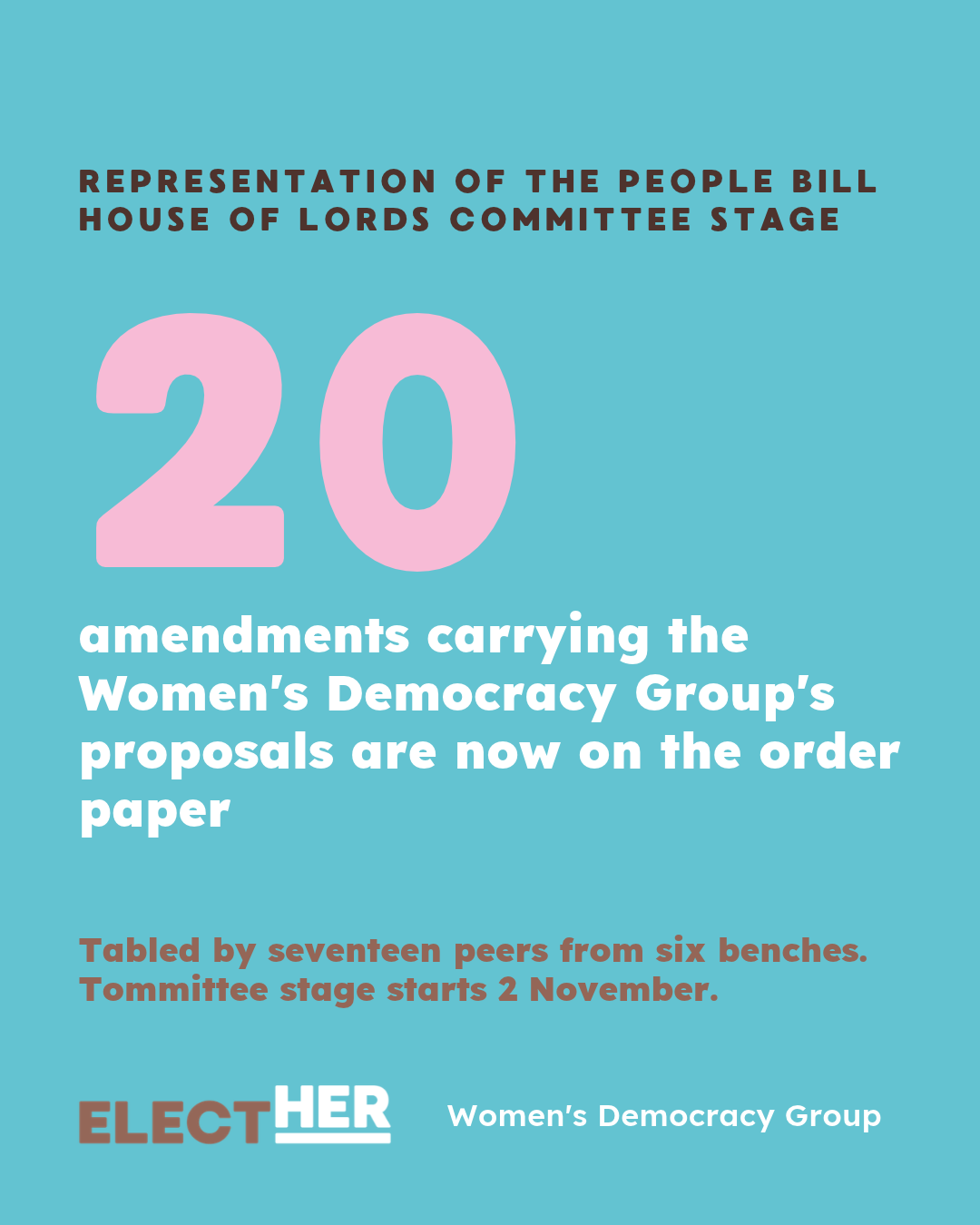
This week, as committee stage opens, we can say where that has got to. Twenty amendments carrying our proposals are now on the order paper, tabled by seventeen peers from six benches, in the names of seventeen peers from Labour, the Liberal Democrats, the Conservatives, the crossbenches, Plaid Cymru and the non-affiliated benches.
That is not a campaign slogan. It is the Lords’ own running list, and anyone can read it.
What is on the paper?
Safety.
Baroness Thornhill has tabled three amendments:
that hostility to a candidate’s family or staff counts as hostility to the candidate;
that the same applies to the aggravating factor the Bill creates;
and that the Electoral Commission must publish safety guidance and returning officers must hand it to every candidate at nomination. At the last general election the government’s own security advice reached a quarter of candidates. Three in four campaigned without it.
Baroness Royall of Blaisdon, Chair of The Jo Cox Foundation, has tabled the amendments the The Jo Cox Foundation has been building since the summer:
candidates’ home addresses private by default, rather than published unless you know to tick a box;
domestic abuse recognised in electoral law, using the text Apsana Begum took through the Commons with 38 cross-party MPs;
and a statutory code of conduct for political campaigning, with enforcement, and with every party required to have its own.
Lord Russell of Liverpool has tabled the companion code for electoral advertising.
Online.
Baroness Morgan of Cotes, with Lord Carlile, Lord Clement-Jones and Baroness Royall, has tabled an
elections code of practice under the Online Safety Act, and
an amendment making the main electoral offences priority offences for platforms.
Four names, four benches.
A representative politics.
Baroness Leaman, Baroness Lister and Baroness Thornhill have tabled
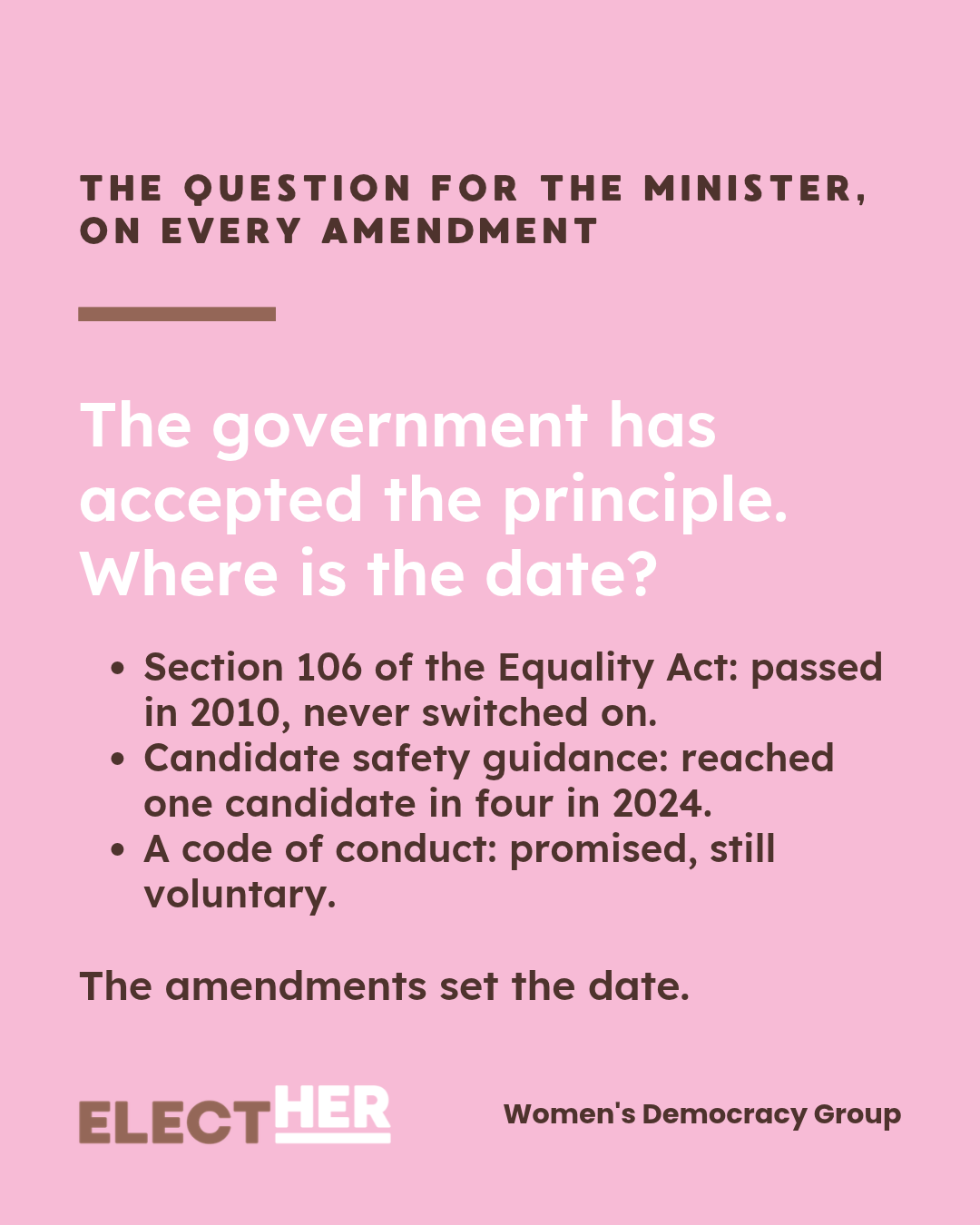
the commencement of section 106 of the Equality Act, the provision Parliament passed in 2010 that would require parties to publish who their candidates are, and which no government has switched on.
Baroness Leaman, Baroness Thornhill, Lord Blunkett and Baroness Grey-Thompson have tabled an Access to Elected Office Fund for England.
Lord Wallace and Lord Rennard have tabled a report on preparing sixteen- and seventeen-year-olds for the vote.
Lord Pack, with Baroness Pinnock, has tabled the data amendments that would let anyone see who registers and who votes, ward by ward.

What the public thinks…
Support is above 85 per cent among supporters of every party, Reform UK included.
While the amendments were going in, researchers at York, Essex and Southampton were in the field. Between 8 and 12 October they asked 1,587 people about a code of conduct for political campaigning.
Ninety per cent want one.
Ninety per cent want it to be legally binding.
Support is above 85 per cent among supporters of every party, Reform UK included.
Fewer than two in a hundred think a candidate’s own party should judge whether she has broken it. Sixty-eight per cent would bar a candidate who posted an opponent’s home address online. Eighty-four per cent think a record of domestic abuse should disqualify someone from standing.
Those are not the numbers of a country that thinks politics has to be like this.
What the government has said
The Minister has written to Baroness Lister confirming that the government “is committed to commencing section 106” and that officials are “exploring when and how”, which is what ministers said in March 2025 and March 2026.
There is no date.
The security review the Home Secretary announced looks at those already elected; nothing in it, so far, is addressed to the people deciding whether to stand.
That is the gap the amendments fill, and it is the question peers will put to the Minister on each one: the government has accepted the principle; where is the date?
What happens next
Committee stage runs over six days: 2 and 4 November, 24 and 30 November, 9 and 14 December. The franchise and registration amendments come first, the safety and representation amendments last. In committee, amendments are debated and usually withdrawn so the government can respond; the votes, if there are votes, come at report stage in the new year.
With the most enormous thank to Peers, to MPs - particularly to Apsana Begum, Anna Dixon, Zoe Franklin - and to all The Women’s Democracy Group - Elect Her, The Jo Cox Foundation, Centenary Action, the Fawcett Society, 50:50 Parliament, , Compassion in Politics, the National Council of Women GB, the University of Roehampton and Shout Out UK, working alongside the Online Safety Network and the Electoral Reform Society.
What unites us is one aim: a Parliament that looks like the country it serves, and a politics that people can enter a politics that people can enter with full support, knowing they are safe.
Donate today to build women up and improve our politics!
Blog idea or comment piece?
Would you like to contribute to this blog series? We’d love to hear from you. Send us your ideas and let’s chat: community@elect-her.org.uk.