
Three weeks, one Bill, seven amendments: where our Women’s Democracy Group has got to
By Elect Her
On 2 September the Representation of the People Bill left the House of Commons with our amendments debated but not written in. On 8 September we packed a hot room in the House of Lords to make the case to peers. On 14 September the Bill had its second reading in the Lords.
This is where things stand, and what happens next…
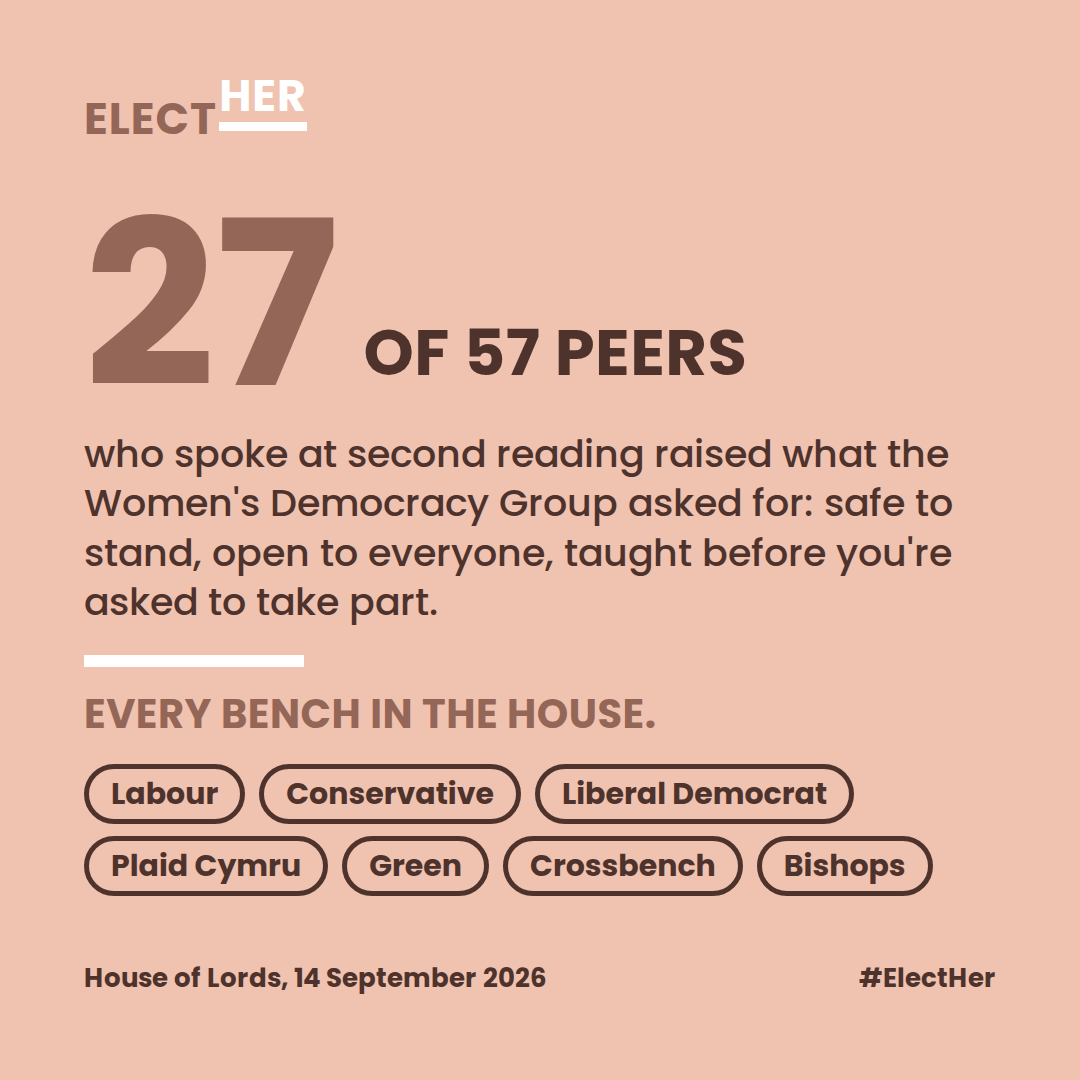
Fifty-seven members of the House of Lords spoke at second reading.
Twenty-seven of them raised something from the Women’s Democracy Group’s briefing.
What peers said
Baroness Royall of Blaisdon, Chair of The Jo Cox Foundation, who hosted us the week before, set out the whole package:
privacy by default for candidates’ home addresses,
domestic abuse offences in the disqualification regime,
a code of conduct for campaigning,
codes for platforms and advertisers,
and political, digital and media literacy education “as soon as the Bill is enacted”.
Baroness Smith of Llanfaes backed the address and domestic abuse proposals and asked the minister directly why the Bill contains no provisions on online abuse…
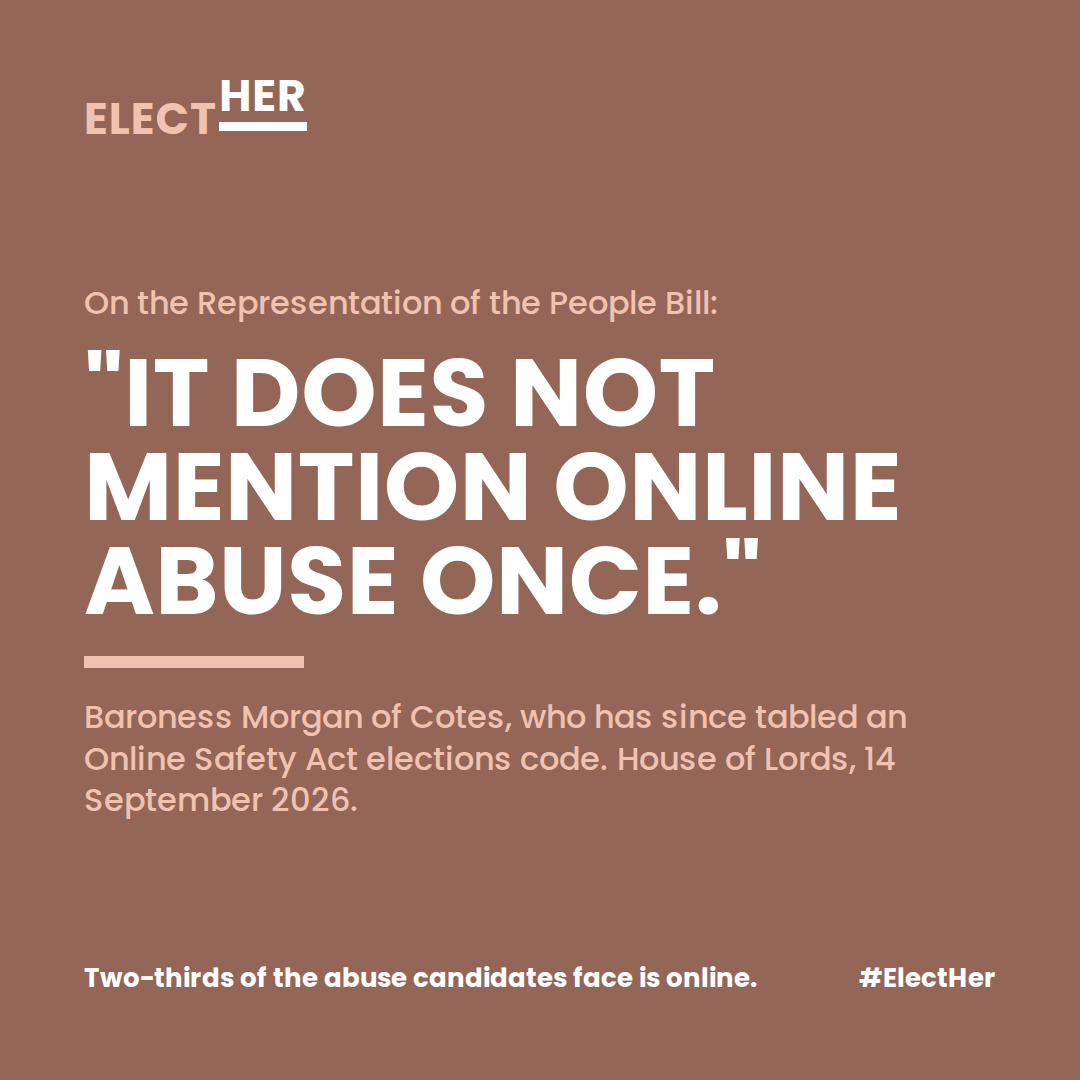
And she wasn’t the only one - Baroness Morgan of Cotes pointed out that it “does not mention online abuse once”!
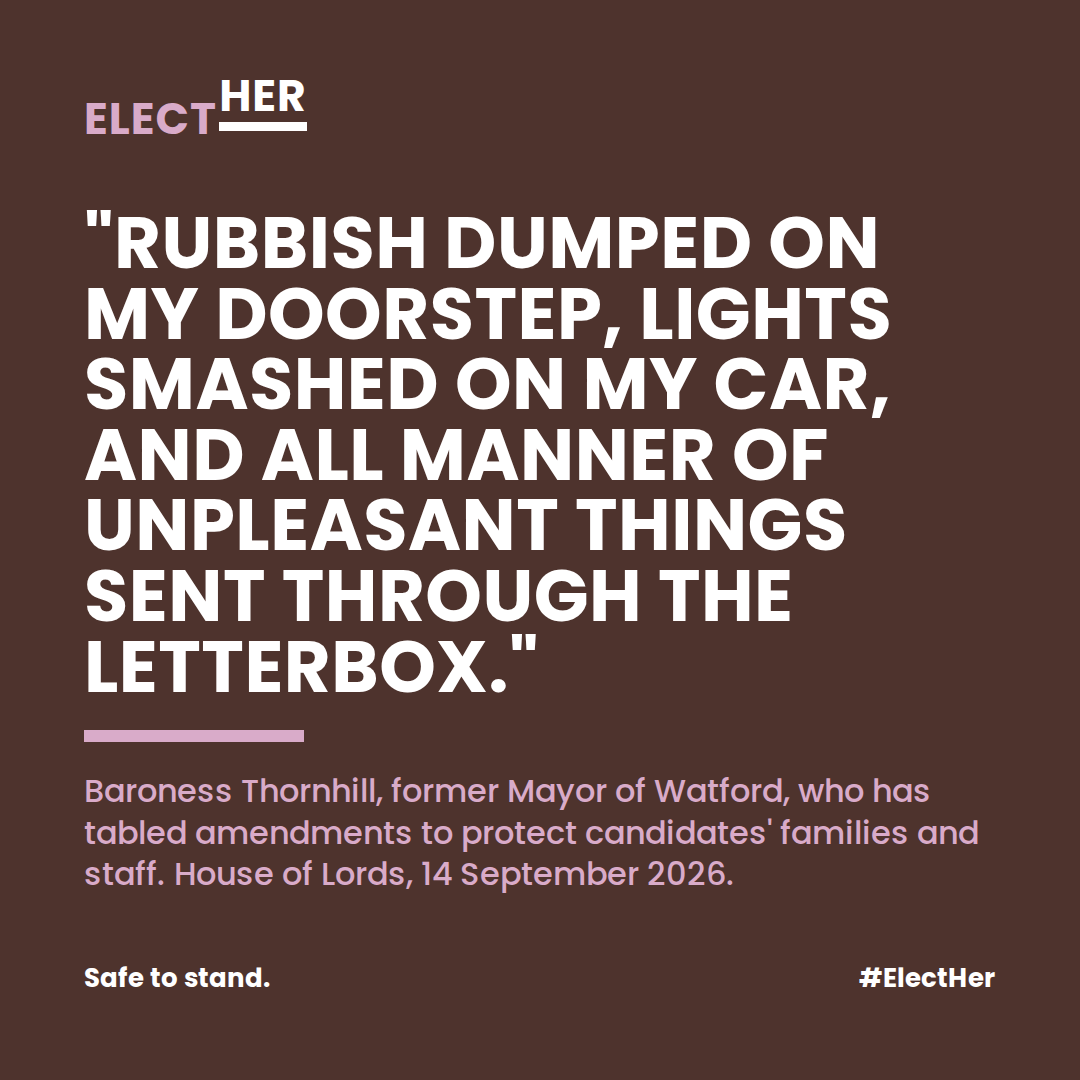
Baroness Thornhill told the House what abuse looks like in practice…
And she told us that not enough had changed since she had stood - and that it is time for it to end.
Baroness Goudie said plainly that abuse “deters many talented women from standing”. Our community agrees! Whilst Baroness Leaman raised Access to Elected Office Fund for disabled candidates - it has existed before and does now in Wales and Scotland - and Baroness Lister called Section 106 of the Equality Act “a vital tool for helping to move the dial”.
Baroness Prashar, Lord Wallace, Lord Bailey, Lord Rooker, the Bishop of Hereford and others made the case for teaching young people how democracy works before they are asked to take part in it.
What this demonstrates, what we know, is that this isn’t one party’s agenda.
What the minister said, and didn’t
Baroness Taylor of Stevenage, closing for the government, said that “we all need to address online abuse as a matter of urgency”, that education and engagement are “a crucial part” of the Bill, and that the government is working with the Electoral Commission, the devolved governments and civil society on “what additional measures we can take to support schools, colleges and youth groups”.
Those are commitments we will hold on to.
She said she would write to peers on the points she could not reach. We look forward to the letter, and to helping peers frame the questions it should answer.
What has been tabled
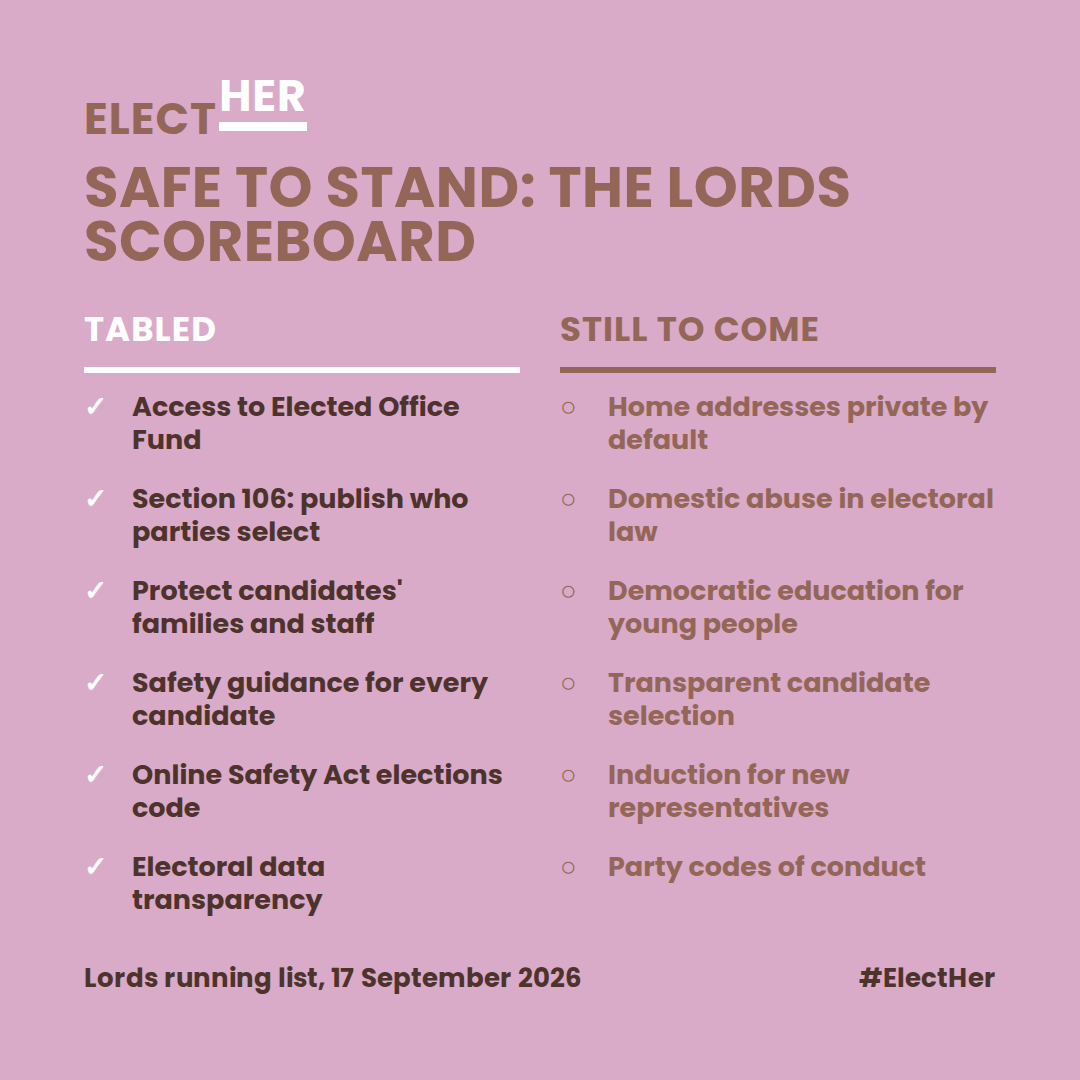
Committee stage is where the text gets written, and the running list of amendments already carries seven from what we had briefed that matters,
The Access to Elected Office Fund, restoring support for disabled candidates in England, is in the names of Baroness Leaman, Baroness Thornhill, Lord Blunkett and Baroness Grey-Thompson: Liberal Democrat, Labour and crossbench on one amendment.
Commencement of Section 106 within three months is in the names of Baroness Leaman, Baroness Lister and Baroness Thornhill - With a companion amendment from Baroness Lister requiring the Electoral Commission to collect and publish the data.
Protection for candidates’ relatives and staff has been tabled by Baroness Thornhill, so that hostility towards them can trigger a disqualification order, and a duty on the Electoral Commission to publish candidate safety guidance within six months, delivered to every candidate by returning officers on nomination.
Two amendments for Online Safety have been tabled by Baroness Morgan of Cotes, with Lord Clement-Jones’ support, an elections code of practice from Ofcom on electoral harms, and the designation of election offences as priority offences.
And Lord Pack has tabled the first two of the electoral data amendments developed with the UK Democracy Fund: publication of registration applications and registrations by ward, and turnout and results data at polling-station level.
What is still to come
Not yet on the list but we are working on it…
Privacy by default for candidates’ home addresses, the amendment Anna Dixon moved in the Commons and ninety councillors, Senedd members, candidates and agents across six parties asked the minister for in an open letter this month.
Nor domestic abuse offences in electoral law,
transparency in candidate selection,
induction for newly elected representatives,
or minimum governance standards for parties.
There is information on each in our briefing, with the evidence attached, and a named contact holding the wording.
Next up is committee stage - where the amendments get debated. The date for that stage has not been announced, so there is time…
If you know a member of the House of Lords, that is the ask: please table what matters to make democracy safer
Who we are
This is all done in partnership - we couldn’t do it otherwise.
With the most enormous thank to Peers, to MPs - particularly to Apsana Begum, Anna Dixon, Zoe Franklin - and to all The Women’s Democracy Group - Elect Her, The Jo Cox Foundation, Centenary Action, the Fawcett Society, 50:50 Parliament, , Compassion in Politics, the National Council of Women GB, the University of Roehampton and Shout Out UK, working alongside the Online Safety Network and the Electoral Reform Society.
What unites us is one aim: a Parliament that looks like the country it serves, and a politics that people can enter a politics that people can enter with full support, knowing they are safe.
Donate today to build women up and improve our politics!
Blog idea or comment piece?
Would you like to contribute to this blog series? We’d love to hear from you. Send us your ideas and let’s chat: community@elect-her.org.uk.